Monday, 24 November 2014

Ambridge Ceramics Christmas 2014 Closure Dates

Talking of Christmas already!?


Ambridge Ceramics Christmas Closing 2014


We just want to make sure that all our clients get plenty of notice so we can ensure no patients are left without their smiles for Christmas.

You can also download the pdf to print and put up on your wall by clicking the link below.

Saturday, 15 November 2014

Ambridge Ceramics continues to support The British Bite Mark

The Dental Laboratories Association are increasing their campaign of The British Bite Mark, a campaign that aims to raise public awareness of where their medical devices are made and as Ambridge Ceramics were one of the earliest members of the scheme we wanted to explain a little more about how we see The British Bite Mark benefitting the public and surgeons that choose to use a high quality lab.

The vast majority of the public are not aware of the different standards of traceability and skill required by each nation that produces dental restorations but in the UK the GDC and MHRA have gone to great lengths to ensure patient safety by demanding high levels of traceability, compliance, professionalism and a commitment to quality of care to patients from their members.

Because all this regulation has been laid out by these bodies solely to protect patients, it seems a good idea to ensure your restorations are made by technicians that have to be registered with and answer to these same bodies?

However there are a minority of dental restorations that leave the UK and this protective framework to be made in countries which do not have the same standards or traceability requirements, often without the knowledge of the patient who will have the medical device fitted.

This is not a simply case of trying to claim that work from one country is good and that from another is bad, but simply asking why the work is being sent offshore? If it is for economical reasons then is the patient fully aware of the option to have the work made within the protective framework setup by a skilled, GDC registered technician and what they are getting for their money?

Is the patient benefitting financially from the cheaper work being made by a lab in a country that is not regulated by the GDC or MHRA? or is the decision being made on their behalf and they are not being given the opportunity to make a choice between saving money or having the peace of mind knowing that their restorations were made by a skilled GDC registered professional?

The key to the whole issue is patient information and consent. If the patient is aware of all the information and still prefers to save money on their medical devices then that is fine, it's simply like the medical tourism which we have seen over the years.

However it's not maybe as obvious for that when many patients are unaware that their restorations were not made by a GDC registered technician within the protective system setup by the MHRA and GDC.

These people are unfortunately unwitting medical tourists who have not had the opportunity to be presented with the facts and weigh up the cost/benefits for themselves.

We live in a massive global economy and there is undoubtedly a benefit to using cheaper labour to keep production costs low, I think we are all aware that most of the technological devices etc. and many of the things we use every day are made this way?

But when we select medical devices and things we consume maybe we would make different choices if the fact were presented to us? The recent spate of health scares which have been reported in the media seems to indicate that some of the cost cutting in these areas has not been in the best interests of the consumers.

Although we don't agree with medical tourism (especially after seeing some of the shocking results that we have had to fix along with our skilled surgeons when some of these patients have come back to them after things have gone wrong) I can see why some people choose the apparent cost savings up front. However, I don't think it can ever be right that a patient becomes an accidental medical tourist because they are having restorations fitted that they are unaware have been made in an unregulated country.

At Ambridge Ceramics we have ploughed hundreds of thousand of pounds into new technology and technician training to continually improve the service we provide to our surgeons and patients, along with submitting to further voluntary independent inspection by a 3rd party assessor to ensure we meet the DAMAS standard ensuring we meet the highest possible levels of traceability and conformity on all our technician training and materials used.

Joining The British Bite Mark was just another logical step in our commitment at Ambridge Ceramics to providing our surgeons with the highest level of quality, traceability, service and support available in the UK, we passionately believe that the standards and skills required to work as a GDC registered technician in UK labs are among the highest in the world and the work that comes out of our lab is also among the best seen anywhere in the world.

If you are a surgeon that uses a British Bite Mark laboratory then please don't waste the opportunity to promote this to your patients, it's a mark of the commitment to excellent quality and service you provide. It may also help to explain to the patient why your service could be slightly more expensive than the practice down the road. Are they offering the same exceptional levels of quality and care?

You are offering a superior level of service, quality and traceability, so why not make that clear to the patient? Be proud to stand out and be known for focussing on offering the very best quality and service and peace of mind that you possibly can.

We have patient information booklets available that you can get by giving Sean a call on 01765 607347 or by contacting The Dental Laboratories Association directly by following this link

So when the campaign hits full swing and more patients start to ask "What's in my mouth?" you will be able to point to The British Bite Mark and demonstrate your commitment to offering restorations that are made in a lab, governed by the MHRA and produced by a GDC registered professional dental technician.

The Dental Laboratories Association have launched a dedicated British Bite Mark website that surgeons can use to find a laboratory but more importantly they have ensures that patients can find a surgeon that can supply them with these British Bite Mark restorations.

Please look at the site and ensure you are listed, this is something we have already started to do this for all clients of Ambridge Ceramics

Ambridge Ceramics Support The British Bite Mark UK Laboratory

Saturday, 20 September 2014

Ambridge Ceramics fly the flag for Great British Dentistry and The British Bite Mark at EAO in Rome

Ambridge Ceramics fly the flag for Great British Dentistry and The British Bite Mark

The team at Ambridge Ceramics have been working together with our surgeons for over a year on the Pre launch for the official UK release of Dentsply Implants Atlantis porcelain fused to titanium screw retained crown units prior to their official launch at the end of 2014.

We are proud to confirm that some of this work will be presented at the EAO in Rome from the 25th to the 27th September 2014

The cases selected had the planning, implant placement and final crown delivery by both Dr Tim Doswell and Dr Kostas Papadopoulos and the laboratory stages were carried out by Lee Nichols & Steve campbell in the CAD design, then milled by Atlantis in Sweden. The ceramic crowns were made by both Mark Ambridge and Jack Gleave who layered these with Creation Ti ceramic. The composite layering was carried out by Iain Baldwin using the Visiolign system from Bredent.

These cases will be highlighting both the clinical and financial advantages of moving to these new implant crowns, regardless of which materia you choose to layer onto the biocompatible titanium crown abutment.

It's a great opportunity for us as a British Bite Mark laboratory to show the leading work that the UK dental profession can produce using the latest CADCAM technology and using the skills and knowledge of an experienced team

Ambridge Ceramics British Bite Mark EAO

This early involvement with Dentsply implants has meant that clients of Ambridge Ceramics have been the first in the UK to offer their patients the benefits and proven aesthetics of porcelain fused to metal crowns but with the benefit of the substructure being titanium, which is proven to have higher biocompatibility than cast alloys or chrome.

Ambridge Ceramics CADCAM titanium implant crown

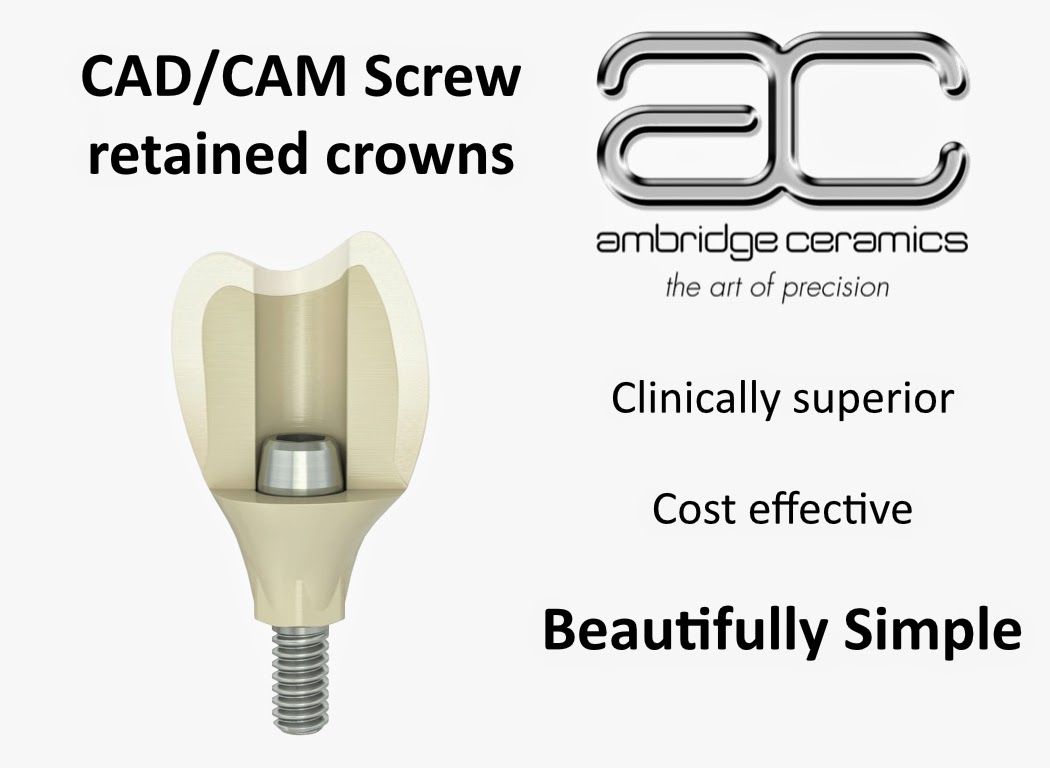
As always, by using the latest CAD/CAM milling solutions we are able to ensure that not only are these crowns clinically superior to those previously available, they are also more cost effective, showing that when CADCAM technology is combined with the skill of the technicians in a British Bite Mark laboratory the results can be ideal for the patients.

There is still some confusion over how these modern techniques are more cost effective so we've tried to break it down below to show a comparisson of the old cast techniques vs. the new CADCAM milled titanium structures offered by Dentsply Atlantis.

The reason for the confusion is that traditional pricing is actually quite confusing. You need to combine all the lab costs, alloy and then the separate billing for the components needed to make the crown from the implant companies, and this bill will usually arrive separately from the work as it's ordered on your account and billed on the day the implant company sends it to the lab.

This leaves your admin team with alot of separate bills to tie up. Here's an example of the true cost of an traditional screw retained implant crown.


Traditional screw retained implant crown costs

So when all the costs are combined, it's pretty expensive! And that is using either casting alloy or cast chrome, neither of which are as biocompatible as the titanium option Dentsply Atlantis crowns offer.

So here's how the costs break down on the new Atlantis titanium crowns

CADCAM Dentsply Atlantis Titanium Crown Ambridge

And we were deliberately conservative on the calculations of alloy required for the conventional screw retained crown in order to offer as fair a comparison as possible. The truth is that many cases are actually larger and this impacts the case costs considerably, as shown below.

Traditional screw retained crowns vs CADCAM costs

In fact on average we save our clients around £140 per implant crown we restore using Dentsply Atlantis titanium Crowns, which can soon add up to alot of money saved a year. It's also a simple consistent cost regardless of your implant system, so you always know what the total cost of restoring your implants will be when quoting your patients.

Atlantis Titanium crowns from Ambridge Save money

Now you may not necessarily want to spend that saved £7000 on a watch, it was just an example of where your wasted money could have gone. But the key point is that this cost saving per implant quickly adds up to a substantial sum of money, which is better in your bank than the implant manufacturer and alloys companies.

As a British Bite Mark laboratory we are always pushing to ensure our clients get the very best in quality and service. Using the latest technology provided by proven industry leading partners we have continually shown that this doesn't have to cost you any more, in fact we have always brought a significant cost saving to our clients with all the CADCAM services we have developed at the lab.

The titanium screw retained crowns will be officially available to the UK late 2014 but we will continue to offer this and many other unique solutions to our clients up until their official launch date.

For more information or to order your screw retained implant crowns you can either contact us by email

sean@ambridgeceramics.com or Call Sean on 01765 607347

You can also download our labcards and postage labels directly from here and send your case into us.

Monday, 8 September 2014

Ambridge Ceramics produces dental implant stent for immediate loading technique published in Dental Practice Magazine

The team were fortunate enough to be asked to contribute their knowledge of Digital Dentistry and CAD/CAM restorations to a challenging case that Dr Mark Willings carried out using the immediate loading technique with his team at Dental Excellence Harewood.

It's always very satisfying to see such great result when working with new implant systems and techniques.

We've been working with the Dental Wings system for many years now to create digital scans of our implant cases, and it's a fantastic system that just gets better year on year.

You can read the full print article using the link below

https://www.dropbox.com/s/vm81oke26nnmicg/Gerald%20Crane%20case.pdf?dl=0

Monday, 30 June 2014

Titanium screw retained implant crowns

In the recent months many of our surgeons have been benefitting from the biological advantages of our porcelain fused to titanium implant crowns.

We have been working as a Beta lab providing these in advance of the official UK and European launch later this year.

Together we have catalogued many of these cases and they will be released after the official UK launch later this year but can give sneak preview of some of our work here.

One of the cases was this one we produced for Dr Papadopoulos where he had created the emergence profile that he wanted copying and captured that using a custom pickup which we could copy when producing the final crown.


Dr Papadopoulos shares his experience with this new solution

"Screw retained titanium bonded implant crowns provide an excellent restorative solution in many clinical situations.

Atlantis screw retained abutments feature a unique patient based anatomical shape and an optimal emergence profile. This provides excellent soft tissue support necessary for the long term success of the implant supported restoration. Soft tissue conditioning combined with Atlantis based final restorative option provides an outstanding aesthetic outcome.

A major advantage of a custom milled titanium abutment over a traditionally available milled screw-retained Zirconia abutment is proven strength and biocompatibility due to hemidesmosomal tissue attachment. Conventional advantages of screw-retained implant supported crowns include more straight forward fitting procedure, no use of cement at fit, ease of retrievability and ability to use them in cases with short restorative space.

New ceramic systems have overcome traditional issues with bonding to titanium and provide an outstanding aesthetic outcome.

Another major advantage in the current economic climate is that this is one of the most cost effective restorative options available to date.

The team at Ambridge Ceramics is very experienced with implant-supported restorations, and is always available for case discussion and laboratory based input which is always extremely helpful in treatment planning.

I am very pleased with the results I get working with Ambridge Ceramics and can highly recommend them."  

                     Dr Kostas Papadopoulos BDS, MDentSci Rest Dent.
                                                Bupa Dental Centre, Canary Wharf.

After the official UK launch we will be able to share many more cases that have been catalogued by our surgical partners throughout the UK.

The results have been brilliant, with our ceramic team relishing the challenges of working with these new CAD/CAM solutions to produce some beautiful screw retained implant crowns with the advantage of being milled from a biocompatible material.

With this in mind we design the abutments to leave titanium against the tissues sub gingivally to ensure maximum biocompatibility and reduced risk of any tissue irritation by composite or ceramic material being deep sub gingival, which if not finished and polished correctly could attract plaque and lead to future complications.

By using using the Atlantis custom milled titanium abutments we can continue to ensure the quality and reassurance that comes from the leading worldwide provider of milled custom abutments, along with a comprehensive warranty covering both the abutment and fixture that it is restored upon.

In addition to the clinical benefits there is a significant cost saving to using these clinically superior crowns, for example you could be wasting well over £100 per fixture compared to a traditional cast screw retained crown, as shown below.


It could be surprising to see how much your traditional screw retained crowns are costing you.


Traditional cast gold methods


CAD/CAM Titanium Option


Or much more on larger molar cases where more metal is needed to support the porcelain work.


But with Atlantis CAD/CAM Screw Retained Implant Crowns you have the benefit of consistent cost effective pricing, regardless of the size of the crown.

Screw retained titanium crowns save well over £100 per fixture restored.


One price, regardless go implant fixture which makes it very easy to work out your lab costs


With this being an Atlantis milled titanium abutment you also have the benefit of their market leading milling quality that is backed by a lifetime warranty on both the abutment and the fixture it is restoring.

Clinically superior and consistently cost effective.


We have been working with Atlantis from it's initial launch in the UK and have more information on all the benefits of this system on our Atlantis abutment page
If you would like a price comparisson for your implant system or would like to offer porcelain fused to titanium screw retained crowns to your patients then please give us a call on 01765 607347 or email sean@ambridgeceramics.com 

Learn more about our lab on our Website


Friday, 21 March 2014

As an implant dentist how much does poor lab support cost you?

Have you looked at the total cost of your implant restorations lately?

By that I mean the TRUE cost, both components and lab bills?

On our many Roadshow tours of the UK it was always surprising to see how many surgeons were wasting money and getting clinically inferior results.

So today I am going to share the slides form a short presentation we give that explains exactly how many surgeons are losing money without realising it.


How much does bad advice and support on restoring dental implants cost you?

Save money on dental implants


That's a lot of money, so how do we get to such a high figure? We start with showing the true cost of restoring your dental implants.

the real cost of restoring dental implants

We use a true average costs which includes the cost of the components from the implant supplier and an average lab cost.

Dental Implants stock abutments cost

These component prices are including VAT and are correct as of 14/03/14

CADCAM abutment costs
So on a like for like comparison of a cement retained implant option the clinically superior Atlantis custom titanium abutment not only avoids an compromise as it is completely custom designed for each patient. It also saves you £42.21. A win/win.

But that doesn't get us to our £5995 over 50 implants does it?

To see where the real genius of using Atlantis titanium custom abutments comes in we need to look at the latest solution.

Ceramic bonded to titanium screw retained implant crowns from Ambridge Ceramics

Even with the cost saving of an Atlantis abutment over a stock we still have the cost of a crown on top to finish the restoration.

On average the cost of a bonded implant crown or all inclusive cost of a traditional cast screw retained crown including components and alloy is anywhere from £100 -  £200

CADCAM titanium screw retained implant crown Ambridge Ceramics

So if we looked at an atlantis abutment at £279.99 plus the cost of a crown at £150 we get a total of £429.99

Our all inclusive titanium screw retained crown will save you £120 for every implant restored.

We have the biological benefit of these being titanium, a material we know is well accepted by the body.

Experienced CADCAM dental laboratory

And that is simply how we get to this fact. If you are being badly advised and supported then it is costing you enough over 50 implant restorations to add up to the cost of a brand new supermini car.

CADCAM implant abutments save money

We have taken great care to check all our figures and supply custom calculators and pdf breakdowns depending on the implant system you currently use.

Dental implant cost calculators from Ambridge Ceramics


And our all inclusive price of £319.99 is regardless of the implant system you use. so there's no more need to have to constantly keep up to date with the changing prices of various implant companies components. We take care of everything for our surgeons.

Dental laboratory that reduces stress

We were one of the first Beta labs for both Atlantis and ISUS in the UK. We really do know our stuff when it comes to these solutions and have the confidence of years of experience and thousands of abutments supplied to our clients.

Ambridge Ceramics Atlantis ISUS

Which allows us to concentrate on what really matters to the patient. A beautiful and predictable final result from our highly skilled ceramic team.

Ambridge Ceramics beautiful aesthetics and cosmetics

Clinically, biologically and financially superior restorations delivered to your patients using our knowledge of CAD/CAM. No compromises. A win/win situation for all involved.

Isn't that what technology, skill and experience combined should deliver?


A truly supportive dental laboratory


For more information please contact sean@ambridgeceramics.com or call Sean on 01765 607347


Sunday, 23 February 2014

Dentsply Launch the Astra Tech EV implant system.


On Friday we were in London for the Official UK launch of the Astra EV implant system! 

This was completely new for most of those attending the exclusive event in London, but for almost a year now we have been secretly working with Dr Mark Willings and Dentsply in restoring the EV implants that he has been working with as part of the Ambassador program.


The design philosophy of ASTRA TECH Implant System EV is based on the natural dentition utilizing a site-specific, crown-down approach supported by an intuitive surgical protocol and a simple prosthetic workflow.


The EV system is an evolution of the already very successful Astra implant system, and now incorporates new design features that improve upon an already class leading and clinically proven implant system.

From a laboratory point of view there is nothing tricky about switching to this system but there are some nice touches, such as a unique index system that will only allow custom made abutments to seat in one position. This is also obviously a huge benefit for the surgeon as they don't have to worry about them seating in one of several possible positions as we do with existing implant systems.

If anything Dentsply have managed to simply improve the user friendly appeal of the already successful Astra system, and build upon the strength and clinically proven results they already provide with the existing implant and restorative range.

It’s been really difficult for us to keep this under our hat as we have naturally been very excited and keen to share the work we have done with the EV implant system. The whole team are honoured to be included in the Ambassador phase of this implant system’s worldwide pre launch roll out and as today is the official launch, we can finally share it with you (although we're not going to share too many details on the systems specifics, we'll leave that to Dentsply)

Here are a few of the many cases we have restored under prescription and guidance of Dr Mark Willings, who was selected from a handful of surgeons worldwide to work with the EV implant system during the pre launch phase.

CASES


It’s obviously a huge honour to be trusted to work on a confidential project such as this one, especially as we have had early access to some of the nice touches that this system brings to the lab when restoring implants, but more importantly for us was the opportunity to feedback on the experience from the lab.

As you would expect we have only used the very best restorative solutions and avoided all potential compromise when dealing with these new EV cases. This has been the Atlantis system for single units and Atlantis ISUS system for multiple unit cases (which is our protocol on all Dentsply implant systems)

The requirement for these cases was that they should be screw retained crowns or bridges, although we do have 1 cement retained case and a couple that were screw retained using lateral fixing screws.

Here is a sneak preview of some selected shots that have been taken from the large variety of cases that Dr Willings presented at The Royal College of Physicians on Friday. We will also have the final fitted pictures to show after Mark has presented them at the launch today. For now we have the images of the lab work we produced on the new system.

Case 1 - 2 Atlantis abutments with a 3 unit bridge, retained with lateral fixing screws


First we designed 2 Atlantis abutments and then Lee tapped them both to accept Bredent Lateral Fixing Screws. Abutment design and framework by Lee Nichols


We then produced a framework which is secured into place with the screws. Ensuring we have a screw retained solution and avoid any issues with the access holes coming through the buccal of the restorations


The screws are slightly flush to the restoration so that after torquing into place the surgeon can trim them flush with the contoured surface of the back of the tooth.


Although this is still screw retained, we have managed to remove the access hole which would have been coming through in the aesthetic zone.

Case 2 - Screw retained molar crown

The final crown that was layered with e.max ceramics by Mark Ambridge


With this case the patient requested a screw retained zirconia crown abutment, so we used the Atlantis system to design a zirconia sub structure that we could layer the ceramic directly onto.


The final abutment was designed and adjusted by Steve Campbell using the Atlantis Web-order Editor interface


You can see from the image below that we used the Atlantis crown proposal to ensure we provided optimal support for the ceramic on the final crown


Case 3 - Full arch Atlantis ISUS milled chrome and ceramic layered bridge

This case was a full arch that was scanned and designed from an immediate denture made by Mark Price, which was later converted to an immediate fixed restoration during the patients transition from temporary denture and guide to our final restoration. An effective way of working back from great prosthetic planning, which perfectly matches the EV crown down philosophy.

The final bridge that was layered with Creation ceramic by Jack Gleave


CAD design stages that show how we used a copy of the immediate restoration which was modified for a more natural tooth emergence by Iain Baldwin, because the immediate had a flange that the patient did not want on the final restoration. 


The patient wanted the overall appearance and function copying, so this became our guide. We have made the final guide transparent so that you can see the CAD framework design within.


Here is the CAD proposition of the final framework we received from Atlantis ISUS.


By using Atlantis ISUS we ensure we get a perfect framework to support our final frameworks, we prefer to offer a framework that is clinically proven to offer a superior level of fit which in turn leads to successful long term restorations.


You can see from this image that the new multi unit abutments have a wider diameter implant screw.


I know we've only shared a select few images and cases from all the work we have done here, but I wanted to keep this as brief as possible and just share the experiences and benefits we have had using the new EV system. However after the launch event we will get the final images from Mark and upload the full set and more detailed case write ups in a separate blog

SUMMARY FROM A LAB

Many of the modifications made in the EV system are just nice little adjustments that make the system very easy and predictable to work with and we found no issues at all in the cases we restored.

The biggest noticeable change is a completely new index system that moves from a hex to a spline and allows for easy seating and positive single position only engagement of all Atlantis CAD/CAM restorations, as shown in the image below


All the components are now colour coded, from pickups and analogues right through to screws, which makes it easy to quickly visually verify you are using the correct components for the EV implant system. Also all the screws have the same 25 Ncm torque value to keep the system simple and user friendly.


There are a wide range of restorative options for the lab, although we have always preferred to stick with the CAD/CAM custom solutions.


Pickup components


Why talk about pickup components in a lab view? Here's why.

One handed self guiding pickup component which will not screw down until correctly engaged

How many times have you cast a model, made a beautiful CAD abutment and crown only to be informed that they were unable to fit it? After casting a new model with a new fixture pickup and comparing with the old cast and impression we find that the rotation and height differ, telling us the initial pickup was not correctly seated.

We're not criticising the surgeons here, traditional implant pickup components are not as user friendly as the EV system and therefore allow for technical errors, especial when having to work in a limited space and with what may not be the most co operative patient.

The Astra Tech EV System has a unique new patented pickup system that means the pickup component is self guiding and will only allow engagement and screw down when it is in the correct position. No more inaccurate implant pickups!


Option for capturing the soft tissue architecture

Again initially this doesn't seem like such a big problem, but from much experience we know of several cases where the surgeon had developed a soft tissue site and the pickup component was so big that all we saw was a big round hole where the nice anatomical tissue site should have been. In effect we had a beautiful replication of a big round pickup cylinder and not the custom tissue site we wanted.

With the Astra Tech EV system they have pickup components that allow for the capture of the cost tissue architecture, and although these are slim when you look at the design of the body and all the facets it incorporates we see that they have actually managed to produce a very retentive surface with a large overall surface area to ensure stability within the impression.

As the vast majority of our abutments are CAD/CAM custom abutments it makes sense that we contour this exactly to the soft tissue architecture that the surgeons have worked so hard to develop, leading to a superior final result for us all.


As shown the reason we are a big fan of the healing abutments is that Dentsply have managed to address the issues that cause technical difficulty or lead to false information on some of the other implant systems.

Site specific healing abutments

This system has a wide range of different healing abutments that are ovoid, round and triangular, ensuring that the surgeon can develop the soft tissue site in a wider range of options that more naturally mimic tooth root shapes than just a standard round pickup.


The reason that we as a lab are so excited and have come to love this system so much is the simple fact that most of the improvements incorporated into this system are technically driven. Therefore designed to eliminate mistakes or mis information that can cause a case we've worked so hard on to either not be fitted or not have the result we would have wanted because the information in the impression was inaccurate in some way, either implant or soft tissue site.

Astra Tech stated that this was a crown down philosophy driven design change and they are absolutely good to their word. We've greatly enjoyed working with this system for a year and look forward to seeing many more come into the lab.

Along with our work with Dr Willings were some great presentations by some of the surgeons that were involved in the ambassador program. Dr willings showed a detailed walkthrough of the cases and final fitted pictures of all the work we had produced together.

Dr Mark Willings presents his EV cases

Dr Mark Willings shows some Astra Tech EV restorative implant cases


Dr Michael Norton who was heavily involved in the design changes for the new system, so it was great to hear from him first hand all the new design considerations and technical reasons for the improvements. 

He stressed that the BioManagement complex that had made the existing OsseoSpeed such a success had not been changes, all the modifications were technical ones to ensure improved restorative procedure and predictability. Which was obvious from our experienced with the system

Dr Michael Norton displays the unique new EV index system

Dr Michael Norton demonstrates the unique new EV spline index system


We then had a very interesting and detailed talk by Dr Kia Rezavandi on the simplified drilling procedure and surgical kit of the EV system. You can hear his thoughts (among others) on the system in the testimonial video at the bottom of the EV site http://www.jointheev.com

DR Kia Rezavandi Demonstrates the EV surgical tray concept

Dr Kia Rezavandi preview the Astra Tech EV surgical Kit


After a break we were then presented with some cement lovely retained restorations of Atlantis abutments by Dr Stephen Jacobs, who also went into great detail regarding the pickup components and various implant sizes, including the benefits of a more flexible site specific approach that the EV system brings. As you'd expect this presentation was very detailed, showing some lovely work which well received by those attending.

Dr Steven Jacobs shared his cases and also gave a great presentation on EVolution 
and why we must always strive to improve.

Dr Stephen Jacobs talks about Astra Tech EVolution


Thank you to the whole lab team who have kept this quiet for so long and worked so hard on all stages of the many cases we have restored over the last year. There were many more ceramic cases by Marc Tocher and Rachelle Webb that we have not shown, along with James Kelly, Ollie Ambridge & Andrew McAuley who were involved in all the CAD and preparation stages for these cases. The whole team behind the scenes that makes it possible for us to take the time to work on and catalogue all the images for a big projects like this, it truly is a team effort. 

Finally we'd also like to thank Dr Willings and Dentsply for choosing us to work with them on a project this big and exciting and also to everyone attending the event who were so complimentary regarding the quality of the cases we were showing.

From Left to right - Dr Mark Willings - Mark Ambridge - Chris Orpin - Steve Campbell

Steve Campbell Mark Willings Chris Orpin Mark Ambridge Astra Tech EV Launch

We recently realised that five years ago we were at Altitude in London for the official launch of the Astra Atlantis system, which has gone on to revolutionise and dominate the CAD/CAM restorative market on all the major implant systems. Another great EVolution was launched here, and maybe this will go on to do the same for the surgical implant side?


There's more news to come


I’m not about to let the cat out of the bag just yet, but we do have a few more very exciting market leading projects still ongoing. Watch this space!

Want to know more about Astra Tech EV? Here is a link to the pdf

For more information on this or any restorative solution at all from us please contact

sean@ambridgeceramics.com

or visit our site for full contact details

http://www.ambridgeceramics.co.uk/contact/